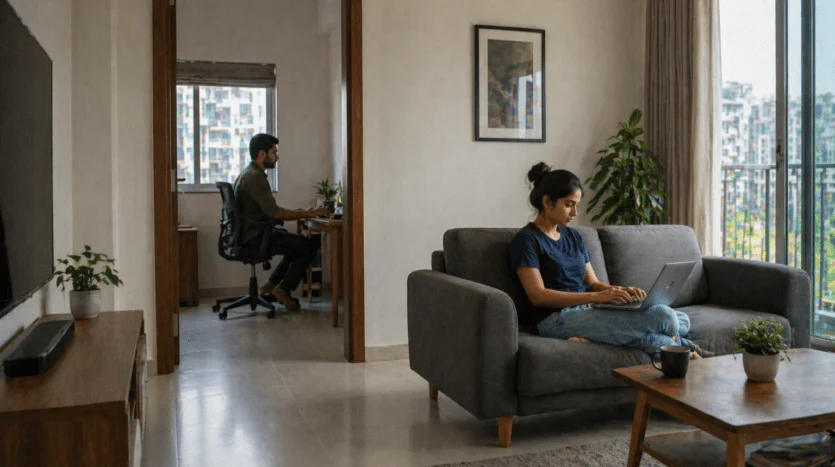
There’s a particular moment in every serious homebuyer’s journey when the shortlist stops changing. You’ve visited enough projects, read enough brochures, and talked to enough brokers to know where you’re actually going to land. For a growing number of buyers in Bengaluru, that moment keeps pointing to the same corridor: Sarjapur Road.
This isn’t about hype. Sarjapur Road has been “the next big thing” for so long that the phrase started to feel hollow. But something has shifted in the last 24 months. The corridor isn’t speculative anymore. It’s expensive, it’s crowded, and depending on the time of day, it’s frustrating to drive through. And yet, the 3 BHK segment here is consistently oversubscribed at launch. That contradiction deserves an honest explanation, not a glossy one.
This guide is written for buyers who are somewhere between seriously interested and genuinely confused. It covers prices, infrastructure, the school ecosystem, commute reality, and the investment case. Where the picture is positive, we’ll tell you why. Where it gets complicated, we’ll tell you that too.
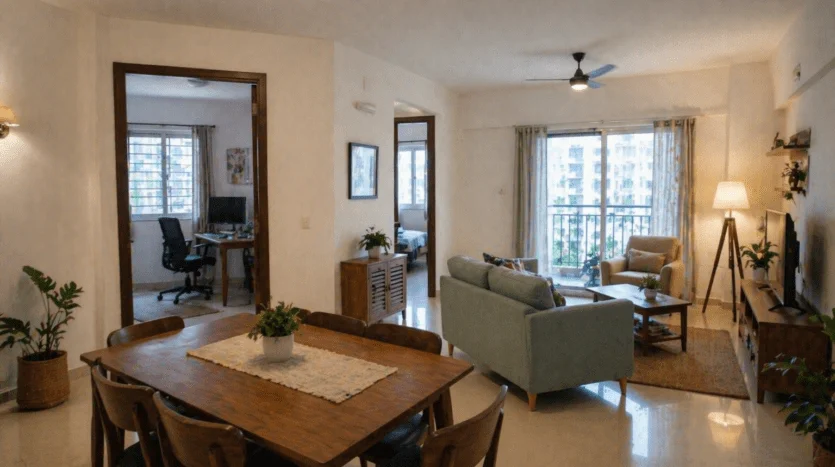
A few years ago, a 3 BHK in Sarjapur Road was a decision you made when your family grew or your income crossed a certain threshold. Today, it’s increasingly the first serious purchase, not the second.
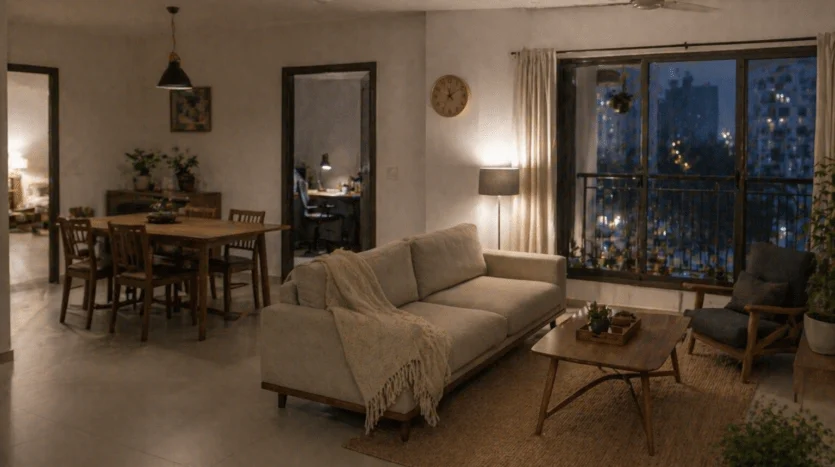
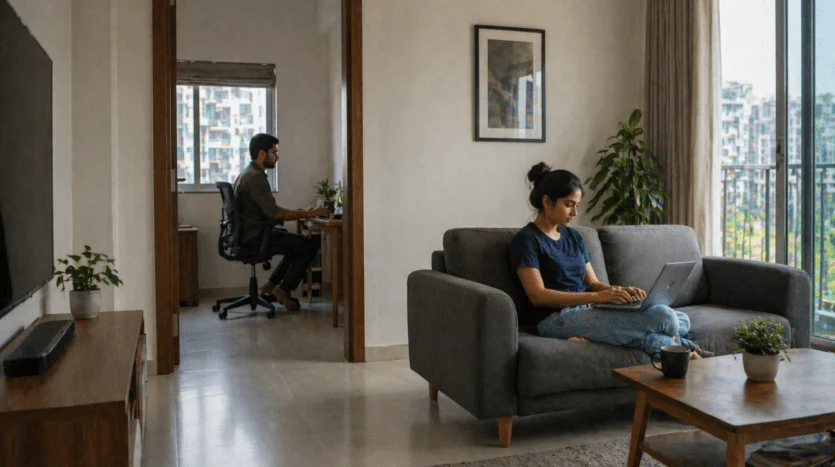
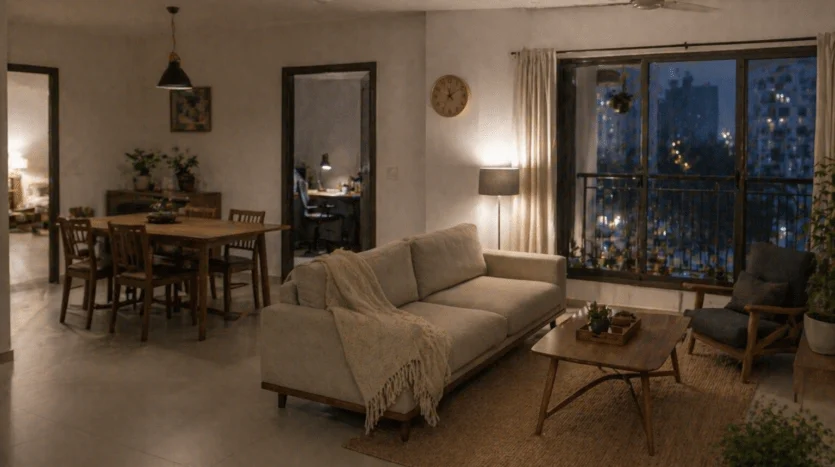
The shift is rooted in how work has changed. Hybrid schedules are now the norm across most of the IT companies clustered in this corridor — Wipro, Accenture, Microsoft, Infosys. When three days a week are spent at home, the architecture of the home stops being incidental. The third bedroom stops being hypothetical and starts being functional: a dedicated workspace that doesn’t bleed into where your family eats or sleeps.
What buyers are actually evaluating now:
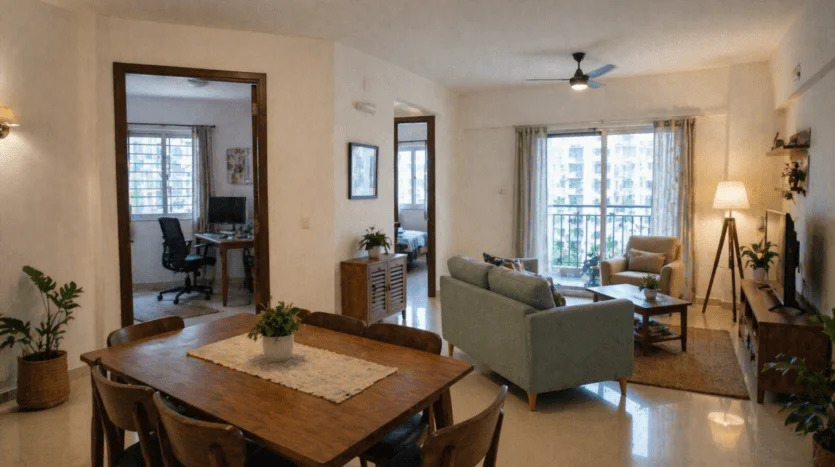
The 1,450 to 2,000 sq ft range that defines most 3 BHKs in this corridor is not accidental. It’s the minimum footprint for a household of four that includes one or two work-from-home professionals without the home feeling compressed. Projects that have prioritised no-shared-wall design and cross-ventilation — features that sound like architecture jargon until you’ve lived in a flat that doesn’t have them — are seeing noticeably stronger demand at both the buying and rental stages.
For families with children, the calculus adds another layer. The third room becomes a child’s bedroom, the home office shifts to the dining area or a corner of the master bedroom, and that compromise is what drives buyers back to the 3 BHK even when the budget strains. The functional logic is clear, and it isn’t going away.
Sarjapur Road is no longer a single price band. The variance across the 21-kilometre corridor is driven less by the label on a project and more by the specific micro-zone it sits in.
The broad price picture:
What this means for a 3 BHK buyer:
| Locality | Avg. Price (₹/sq ft) | 3-Year Appreciation | Rental Yield |
| Sarjapur Road | ₹9,000 – ₹19,000 | 38%–89% | 3.5%–5.5% |
| Whitefield | ₹12,000 – ₹13,000 | 28%–34% | 3.0%–4.0% |
| HSR Layout | ₹20,750 – ₹33,350 | 18%–22% | 3.0%–3.5% |
| Electronic City | ₹4,000 – ₹8,000 | 22%–28% | 4.0%–5.0% |
HSR Layout is now priced out of most first-time 3 BHK buyers. Whitefield offers stability but a compressed appreciation runway. Electronic City has yield but lacks lifestyle infrastructure. Sarjapur Road sits at a crossroads: still accessible, but clearly on a premium trajectory. The buyer who waits for prices to correct is likely waiting for something that corridor data doesn’t support.
Infrastructure is where buyer optimism and market reality diverge most sharply on Sarjapur Road. Here’s a clear-eyed breakdown.
What’s proposed:
Current status (as of early 2026):
What this means for you:
These are the more realistic near-term infrastructure wins:
The Sarjapur main road widening is also in progress. It has temporarily worsened congestion during construction but will meaningfully improve corridor experience within two to three years.
For buyers with children — or buyers planning for them — Sarjapur Road’s concentration of schools is one of the most underrated factors in the purchase decision.
The school ecosystem at a glance:
The fee range is significant. This isn’t an ecosystem serving only high-income families; it covers a wide demographic band, which is part of why the demand anchor here is so durable.
Why this matters to a buyer beyond the obvious:
Beyond schools, the corridor includes Manipal Hospital, Motherhood, and Sakra World Hospital — a healthcare concentration that matters significantly for joint families and buyers with elderly parents. Together, these amenities create a self-sufficiency that reduces long-term dependence on the broader city grid.
Suyug has consistently prioritised proximity to this ecosystem in its project selection on Sarjapur Road — a positioning that reflects a genuine understanding of what retains value over time, not just what sells at launch.
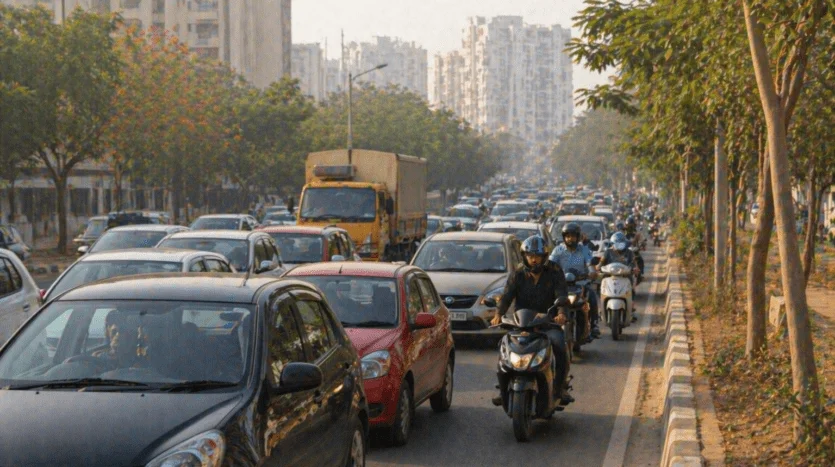
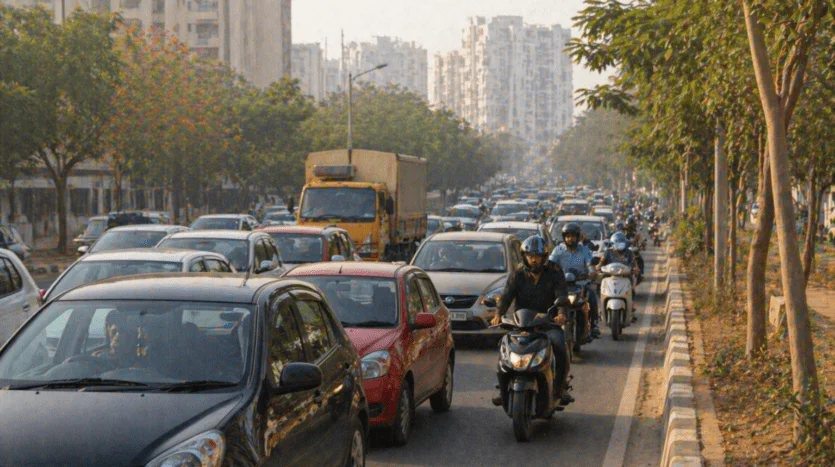
The single biggest source of buyer regret on Sarjapur Road isn’t the price. It’s the commute. The gap between what brochures claim and what residents experience is wide enough to warrant its own section.
“20 minutes to Whitefield” is technically true at 11 PM on a Sunday. At 8:30 AM on a Tuesday, the same journey routinely takes 75–90 minutes.
Commute times by destination (peak hours, 8–10 AM):
How to think about this:
If you work on-site five days a week and your office is in Whitefield, be honest about the mental cost of 90-minute commutes compounded over months and years. If you work from home three or more days a week — or if your office is within the corridor itself at Wipro HQ or RGA Tech Park — the commute calculus shifts decisively in favour of the location.
The PRR, once operational around 2027, will meaningfully change inter-zone movement. Until then, the commute is a real variable, not a footnote.
The 3 BHK on Sarjapur Road is increasingly being evaluated as a dual-purpose asset: a place to live today and a performing investment over a 5–7 year horizon. The data supports this framing, with appropriate nuance.
Rental yield snapshot (2026):
The appreciation case:
The corridor has delivered 89% appreciation over three years in active zones. Projecting forward, an annual appreciation of 10–15% combined with a rental yield of 4–6% points toward materially different asset values by 2031 — the year that roughly aligns with the Metro Phase 3A operational window. Historically in Bengaluru, the infrastructure premium gets priced in 18–24 months before commissioning, which means investors who enter 2–3 years ahead of completion tend to capture the sharpest appreciation.
The practical question for a buyer today: does the entry price already reflect too much of that future value? In top-tier projects priced above ₹15,000 per sq ft, that’s a fair concern. In mid-premium projects in the ₹1.5–₹2.5 crore range — particularly in sub-zones like Dommasandra and Carmelaram — the appreciation headroom remains meaningful.
The quality of 3 BHK inventory on Sarjapur Road is uneven. Price is not a reliable proxy for build quality or long-term liveability.
No shared walls between apartments. This is the difference between genuine privacy and borrowed peace. It’s rarer than it should be at this price point, and worth specifically asking for on any site visit.
Cross-ventilation and natural light. The orientation of a flat relative to the building affects your electricity bill and your daily mood more than any clubhouse feature. Ask which direction the living room faces and where the wind runs through.
Balcony size. Anything under 50 sq ft is functionally decorative. At 80 sq ft and above, a balcony becomes a usable secondary workspace, a morning coffee zone, or a reading corner — which is what it’s supposed to be.
Suyug’s Saffron project — IGBC Silver pre-certified, no shared walls, designed specifically for long-term usability on Sarjapur Road — is a useful reference point for what responsible development in this corridor can look like, regardless of whether it makes your shortlist.
Thinking about buying a 3 BHK on Sarjapur Road? Suyug’s team can walk you through current inventory, floor plan options, and what to ask before you commit to any project on the corridor. It’s a conversation, not a pitch.

The Sarjapur Road story is genuinely compelling. The data on appreciation is real. The school belt is real. The employment gravity from the surrounding IT parks is real. What’s also real is that this corridor rewards buyers who go in with clear eyes about what exists today — the traffic, the dust, the infrastructure that’s years away — versus what will exist when the metro arrives and the roads are finally finished.
The buyers who make the best decisions here aren’t the most optimistic. They’re the ones who’ve modelled both versions of the future and concluded that even the less convenient one is worth it.
Sub-zones like Dommasandra, Sompura, and Carmelaram haven’t caught up to Bellandur pricing yet, so the ₹1.5–₹2.5 crore range still has appreciation headroom. The risk of waiting is that metro timelines, PRR progress, and sustained IT employment continue keeping demand elevated.
Ask for the plinth elevation (600mm above road level is the minimum) and request the stormwater drainage plan. Cross-check your shortlisted project’s land against BBMP’s storm water drain maps — the 2022 ORR flooding is a useful reference point for which areas are genuinely at risk.
Peak hours run 70–90 minutes via ORR; off-peak is 25–35 minutes. If Whitefield is your daily destination five days a week, build that into your decision honestly — the PRR expected around 2027 should improve things, but it’s not here yet.
Target at least 1,300 sq ft of carpet area — super built-up figures carry loading factors of 25–35%, so always ask for the RERA carpet area certificate separately. Anything under 1,200 sq ft of usable carpet starts to feel tight if two people are working from home simultaneously.
For a long-horizon investor in the ₹1.5–₹2 crore range, the 2033 timeline works well as an investment thesis. For an end-user motivated by commute relief, don’t let it drive the decision — buy the location, and treat the metro as the upside.
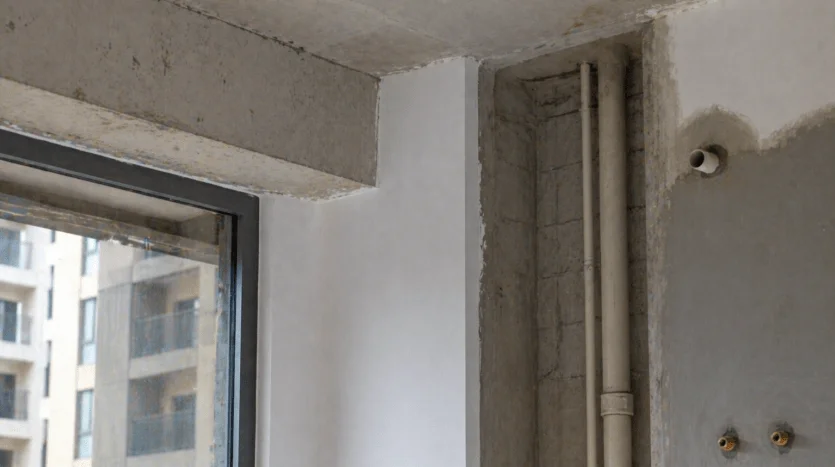
Check concrete slab thickness (125mm minimum for sound insulation), whether waterproofing in wet areas is internal or surface-applied, and ask for plumbing fixture warranties. A site visit during construction tells you far more than any finished sample flat will.
Share it on:


Posted on 04 Jul 2026
3 min read
Posted on 29 Jun 2026
3 min read
Posted on 26 Jun 2026
3 min read
Posted on 26 Jun 2026
3 min read