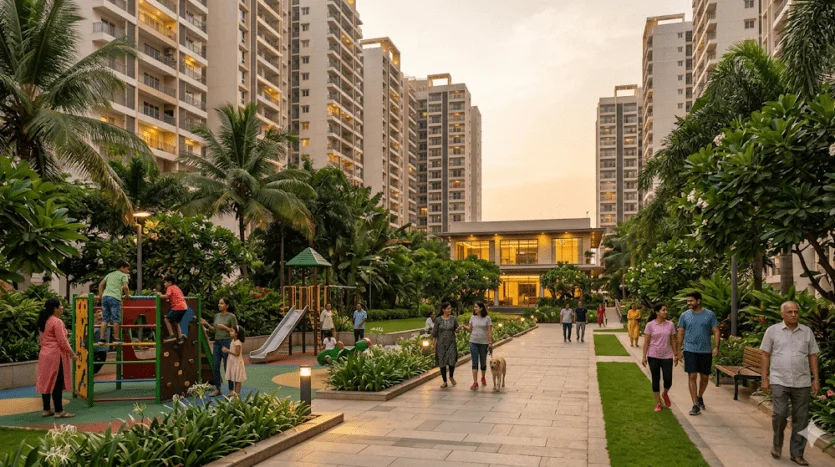
At a certain price point on Sarjapur Road, the choice stops being about configuration and starts being about asset philosophy. A buyer with ₹2.5 crore to ₹5 crore isn’t choosing between a bigger flat and a smaller one. They’re choosing between two fundamentally different relationships with space, community, land, and long-term value.
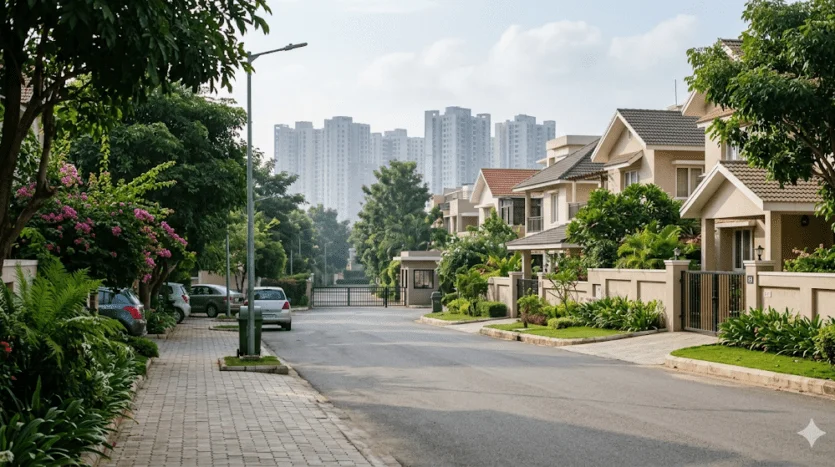
The 4 BHK apartment in Sarjapur Road and the gated villa community may occupy the same price band but deliver entirely different living experiences. One offers density with amenity: a high-rise community of 400 families, resort-style infrastructure, and a lock-and-leave asset that works for global professionals. The other offers land ownership, privacy, and the kind of architectural autonomy that no apartment building can replicate.
Both are legitimate choices. Neither is obviously superior. What determines which one is right is a specific combination of lifestyle priorities, investment horizon, family structure, and risk appetite. That combination is different for every buyer at this price point. This guide is built to help you work through it clearly.
Before comparing lifestyle or returns, it’s worth being precise about what each asset actually is, because the legal and structural difference between the two is more consequential than most buyers realise at the point of purchase.
What a 4 BHK apartment gives you:
What a villa gives you:
This distinction matters enormously for long-term value. In an apartment, the land appreciates, but the appreciation is diluted across units. In a villa, the land is yours entirely, which is why villa plots in established Sarjapur Road sub-zones have historically appreciated faster than apartment UDS values in the same area.
The ownership comparison at a glance:
| Metric | 4 BHK Apartment | Gated Villa |
| Land Ownership | UDS (shared) | Private plot |
| Modification Freedom | Interior only | Structural expansion possible |
| Community Density | High (social) | Low (private) |
| Maintenance Model | Collective, managed | Individual responsibility |
| Rental Yield | 3.5%–5.0% | 2.5%–3.5% |
| Appreciation Driver | Structure + UDS | Land value (primary) |
This is where the two asset types diverge most sharply, and where buyer self-knowledge matters most.
The apartment lifestyle on Sarjapur Road:
A premium 4 BHK apartment in Sarjapur Road sits within a high-rise community of typically 300–600 families. The lifestyle this delivers is specific:
The trade-off is density. Four hundred families sharing common spaces means noise in corridors, lift wait times during peak hours, and the reality that your balcony faces another family’s balcony in many configurations. For buyers who value solitude, this is a daily friction that no amenity list compensates for.
The villa lifestyle on Sarjapur Road:
A gated villa on Sarjapur Road, particularly in sub-zones like Kodathi, Dommasandra, or the plotted developments near Bagalur, delivers a categorically different experience:
The trade-off is a self-sufficiency burden. Security, maintenance, landscaping, and water management are your direct concern. What a high-rise community handles collectively, a villa owner handles individually, which has both financial and time implications.
Both asset types at the ₹2.5 crore+ level carry high costs beyond the base purchase price. Understanding where those costs sit differently is essential for accurate budgeting.
Acquisition costs (on a ₹2.5 crore purchase):
Interior and fit-out costs:
This is where the divergence becomes significant:
Monthly ownership costs:
This is the question most investors lead with, and the answer is more nuanced than either camp typically acknowledges.
On capital appreciation:
Villa plots on Sarjapur Road have historically appreciated faster than apartments in equivalent sub-zones, driven by the scarcity of private land in an increasingly dense corridor. Gunjur and Varthur have recorded 231.8% appreciation over a ten-year horizon — figures that reflect land value growth more than structural value.
Apartments appreciate steadily but the structure itself depreciates over time while the UDS appreciates. In a 20-year window, a well-located villa plot will typically outperform a comparable apartment on absolute capital return — but the gap narrows significantly for apartments in premium, well-maintained high-rises with strong developer brands.
On rental yield:
The 4 BHK apartment in Sarjapur Road wins clearly here:
The investor’s decision framework:
The 4 BHK apartment in Sarjapur Road is not simply a larger flat. At this configuration and price point, it’s a specific lifestyle product that fits a specific kind of buyer.
The global professional or dual-income couple: Travelling frequently, working in high-pressure roles, and needing a home that functions reliably without active management. The apartment’s professional security, managed maintenance, and lock-and-leave infrastructure make it the only practical choice. A villa requires presence; a 4 BHK apartment doesn’t.
The senior executive with a multigenerational household: Four bedrooms in a premium apartment provide genuine room separation — a dedicated home office, a guest suite, private quarters for elderly parents, and children’s bedrooms — without the maintenance overhead of a villa. The fourth bedroom is specifically what converts this from a functional home into a comfortable one for a household of five or six.
The NRI investor seeking a managed asset: Rental yield, liquidity, and managed infrastructure make the 4 BHK apartment in Sarjapur Road the stronger choice for a buyer who cannot be present to manage the asset. Apartment rental programmes, professional property management, and RERA-backed legal clarity all reduce the friction of remote ownership.
What Suyug’s approach to 4 BHK design reflects: Projects designed with dedicated home office zones, no shared walls, dual balconies, and IGBC certification address exactly the needs of this buyer profile — long-term usability over launch-day visual appeal, which is the distinction that holds value at resale.
The villa buyer on Sarjapur Road is making a different kind of decision, one rooted in permanence, privacy, and a specific vision of how their household will live over the next decade.
The multigenerational joint family: Three generations under one roof works in a villa in ways that a high-rise apartment, however large, cannot fully replicate. Ground-floor access for elderly parents, outdoor space for children, a private garden for morning walks — these are structural features that villa design delivers and apartment design approximates at best.
The buyer with a 10+ year horizon and land ownership conviction: If your view is that Bengaluru’s peripheral land will be dramatically more scarce and valuable in 2036 than it is today, the villa is the purer expression of that thesis. You’re buying the land; the structure is secondary. This is a legitimate investment view, particularly in sub-zones like Kodathi and Dommasandra, where land prices haven’t yet reached their mid-corridor equivalents.
The buyer who values architectural autonomy: Adding a floor, redesigning the landscaping, converting a room into a home studio — these are decisions a villa owner makes unilaterally. An apartment owner makes them within the constraints of the building’s approved plan and the housing society’s rules. For buyers with strong views on how they want their home to evolve, this autonomy is not a minor consideration.
Rather than a generic recommendation, here is a framework that maps directly to the decision:
1. How often are you away from home? Frequent travel (more than 10 days a month) strongly favours the apartment. Villa maintenance requires presence or a trusted local manager; neither is cost-free.
2. What is your primary financial objective? Rental income in the near term favours the apartment. Land-driven capital growth over 10+ years favours the villa.
3. What does your household look like in five years? A growing joint family with elderly parents and young children favours the villa’s spatial and generational flexibility. A stable nuclear household of three to four favours the apartment’s efficiency.
4. How important is community infrastructure to your daily life? If your children’s social life, your fitness routine, and your weekend leisure depend on on-site infrastructure, the apartment delivers this effortlessly. If you prefer curating your own environment, the villa’s self-sufficiency suits you better.
5. What is your tolerance for ownership complexity? Apartments abstract away maintenance complexity behind a monthly charge. Villas make it very clear — water management, security arrangements, structural upkeep — and require active engagement. Be honest about how much of that you want to manage.
Sarjapur Road sub-zones don’t favour both asset types equally. Matching asset type to sub-location is the final variable in the decision.
For 4 BHK apartments:
For villas:
Evaluating a 4 BHK apartment or villa on Sarjapur Road, and want to work through which fits your situation? Suyug’s team thinks through these trade-offs with buyers regularly — reach out for a straightforward conversation.
The apartment vs. villa debate on Sarjapur Road is rarely resolved by the numbers alone. The financial case for each is coherent enough that buyers who want to justify either choice can find the data to do it. What actually settles the decision is clarity about how you want to live — not just where you want to invest. Get that right first, and the asset choice follows naturally.
For rental yield and near-term liquidity, the 4 BHK apartment in Sarjapur Road is the stronger investment — yields run 3.5–5% annually versus 2.5–3.5% for villas, and the tenant pool is larger and more consistent. For long-term capital appreciation driven by land scarcity, villas have historically outperformed. The right answer depends on your holding horizon and whether income or growth is your primary objective.
Add 6–7% for stamp duty and registration (₹15–₹17.5 lakh), 5% GST if under construction (₹12.5 lakh), ₹30–₹50 lakh for interior fit-out, and ₹8,000–₹12,000 per month in maintenance charges. The effective all-in cost on a ₹2.5 crore 4 BHK apartment is typically ₹2.85–₹3.1 crore before you’ve bought a piece of furniture.
Villa rentals are less liquid than apartment rentals on Sarjapur Road. The tenant pool for villas is narrower — primarily senior expat executives and large joint families — and tenanting gaps between leases tend to be longer. Premium 4 BHK apartments in Grade-A projects with managed rental programmes consistently achieve higher occupancy rates and lower vacancy periods than comparable villas.
UDS is your proportional ownership of the land beneath the building, shared across all unit owners. It matters for two reasons: it determines your legal claim if the building is ever redeveloped, and it affects the long-term land appreciation component of your asset. Larger UDS allocations — typically in projects with fewer units per floor — are preferable. Always ask for the UDS figure in square feet and verify it in the sale agreement.
Carmelaram offers the strongest combination of confirmed Metro Phase 3A proximity, accessible entry pricing relative to Bellandur, and appreciation headroom. Bellandur and Kaikondrahalli offer the strongest current rental yield but more compressed appreciation runway. For investors prioritising growth over near-term income, Carmelaram is the better entry point in 2026.
Apartment maintenance is higher on paper — ₹8,000–₹12,000 per month versus ₹3,000–₹5,000 for a villa community fee — but villa owners absorb additional private costs: independent security, landscaping, exterior maintenance, and water procurement. Over ten years, the total maintenance spend for a villa typically approaches or exceeds the apartment equivalent when private costs are fully accounted for.
Share it on:


Posted on 04 Jul 2026
3 min read
Posted on 29 Jun 2026
3 min read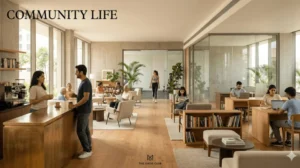
Posted on 26 Jun 2026
3 min read
Posted on 26 Jun 2026
3 min read