
For NRIs based in the US or Canada, understanding how to invest in real estate in India from abroad can feel opaque. The process involves Indian banking regulations, FEMA compliance, legal representation, state-level registration, and cross-border tax reporting, none of which work quite the way property transactions do in North America.
The good news is that the framework is well-established and entirely executable remotely. What it requires is understanding each step in sequence, knowing which documents are needed at each stage, and not skipping the due diligence steps that protect you when you cannot physically be present. This guide walks how to buy property in India as an NRI, from eligibility confirmation to post-purchase rental setup, in a sequence that works whether you are in New York, Toronto, or anywhere else abroad.
TL;DR
Before anything else, confirm which category you fall under; each carries slightly different documentation requirements, though property purchase rights are broadly the same.
The three eligible categories under FEMA and RBI guidelines:
What all three can buy: Residential apartments, villas, and plotted developments; commercial offices and retail spaces; no limit on the number of properties owned.
What all three cannot buy: Agricultural land, plantation property, or farmhouses. The prohibition is absolute under FEMA and cannot be circumvented through corporate structures.

All property-related payments must flow through India-based NRI banking accounts. Paying directly from an overseas account to a developer or seller creates a FEMA compliance gap that can complicate the repatriation of sale proceeds later.
The three account types and their best use:
| Account | Source of Funds | Repatriation | Best Used For |
| NRE (Non-Resident External) | Remitted from overseas | Fully repatriable | Property purchase payments; repatriating sale proceeds |
| NRO (Non-Resident Ordinary) | Indian income (rent, dividends) | Capped at USD 1M/year post-tax | Collecting rental income; paying local expenses |
| FCNR (Foreign Currency Non-Resident) | Foreign currency deposits | Fully repatriable | Staging capital during currency volatility |
For property purchases, the NRE account is the cleanest route, because payments from NRE funds are fully repatriable, protecting your exit flexibility when you eventually sell.
Under FEMA, NRIs are restricted to residential and commercial property. The most common purchase for NRIs buying property in Bangalore is a residential apartment in an established IT corridor, primarily because it combines rental yield, capital appreciation, and eventual personal use.
What to consider when choosing:
Since most NRI buyers cannot be physically present in India for document signing and registration, a Power of Attorney (POA) is the mechanism that legally validates remote transactions.
How to set up a valid POA:
Who to appoint: A trusted family member combined with an independent property lawyer (not the developer’s recommended legal team) provides the strongest protection. The lawyer conducts title searches and reviews the terms of the sale agreement before the POA holder signs anything.

This is the most important step when learning how to invest in real estate in India remotely. This is the step most NRI buyers under-invest in, and the one where most post-purchase complications originate. The distance from India creates a reliance on the developer’s assurances, which is exactly the wrong approach.
Non-negotiable checks before signing:
There are two routes in financing when it comes to how to buy property in India as an NRI.
Route 1 — NRI Home Loan from an Indian lender:
Route 2 — Direct remittance from overseas:
For most US and Canada-based NRIs, direct remittance through NRE is simpler and avoids the complexity of Indian loan servicing. The home loan route makes sense if the buyer wants to preserve overseas liquidity or benefit from Indian interest rate cycles.
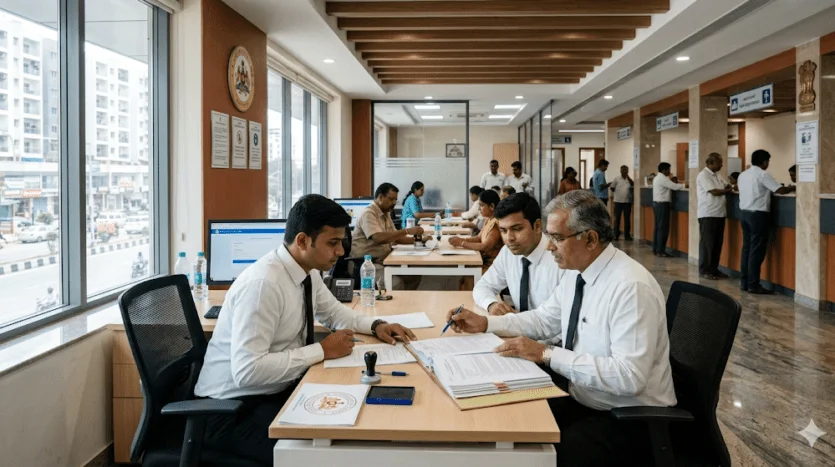
Registration is the legal step that makes ownership official. In Karnataka, it happens at the Sub-Registrar’s office and is executed by your POA holder on your behalf.
Current costs in Karnataka:
Documents required at registration:
The all-in cost reminder: Stamp duty and registration together add 7% to the base price. Add GST (5% on under-construction), sinking fund, advance maintenance, parking, and clubhouse membership, and the effective all-in cost typically runs 15–18% above the quoted base price.
Once the property is registered, the post-purchase framework determines whether it functions as a genuinely passive asset or a management burden.
Rental setup:
Tax filing in India:
Cross-border reporting for US/Canada:
The process flow summary:
| Step | Action | Key Document | Timeline |
| 1 | Confirm eligibility | Passport, OCI/PIO card | Before shortlisting |
| 2 | Open NRE/NRO account | Bank KYC documents | 1–2 weeks |
| 3 | Shortlist property | RERA certificate | Ongoing |
| 4 | Engage a lawyer and POA | Embassy-attested POA | 2–4 weeks |
| 5 | Complete due diligence | EC, title search, RERA | 2–3 weeks |
| 6 | Arrange financing | Loan sanction or NRE transfer | 2–6 weeks |
| 7 | Register property | Sale deed, stamp duty | 1–2 days |
| 8 | Set up rental and tax filing | Lease agreement, ITR | Post-possession |
Talk to Suyug’s NRI investment team: we handle the entire process so you don’t have to be in India. From RERA verification and POA setup to banking compliance and post-purchase management, every step is managed remotely.
The step-by-step framework on how to invest in real estate in India, detailed above, is well-established and entirely workable from the US or Canada. What makes the difference between a smooth transaction and a complicated one isn’t the complexity of the process, but whether due diligence at Step 5 is done properly and whether the POA at Step 4 is transaction-specific rather than general. Those two decisions protect everything that follows.
Yes, via a transaction-specific POA attested at your nearest Indian Embassy or Consulate and adjudicated at the Sub-Registrar’s office in India. The POA holder executes registration on your behalf. Most Tier-1 developers now offer virtual site tours and digital documentation that make the full process remote.
NRE accounts hold remitted foreign earnings and are fully repatriable, making them the cleanest source of funds for property purchase. NRO accounts hold Indian income (rent, dividends) and are repatriable up to USD 1 million per year post-tax. For purchase payments, NRE is preferred; for collecting rental income post-possession, NRO is the standard route.
Visit rera.karnataka.gov.in, search by project name or registration number, and confirm that your specific tower has its own registration, and not just a project-level approval. Check the registered completion date, confirm it has not lapsed, and review the buyer complaints section. This takes under an hour and eliminates most delivery risk for remote buyers.
Stamp duty is currently 5%, and registration fee is 2% of property value — a combined 7% of the base price. On a ₹1.5 crore property, this adds ₹10.5 lakh. These are payable at registration and cannot be deferred. Factor this into your total acquisition budget alongside GST, maintenance advances, and parking charges.
Rental income is declared on Schedule E of IRS Form 1040. Indian taxes paid, including TDS deducted by your tenant, can be claimed as Foreign Tax Credits on Form 1116, directly reducing your US tax liability on the same income. The India-US DTAA prevents effective double taxation in most scenarios.
Add stamp duty (5%), registration fee (2%), GST on under-construction units (5%), sinking fund (₹50,000–₹1 lakh), advance maintenance (₹1–1.5 lakh), parking (₹1.5–6 lakh), and clubhouse membership (₹1–2 lakh). The effective all-in cost on a ₹1.5 crore base typically runs ₹1.72–₹1.8 crore before interior fit-out.

Share it on:



Posted on 04 Jul 2026
3 min read
Posted on 29 Jun 2026
3 min read
Posted on 26 Jun 2026
3 min read
Posted on 26 Jun 2026
3 min read