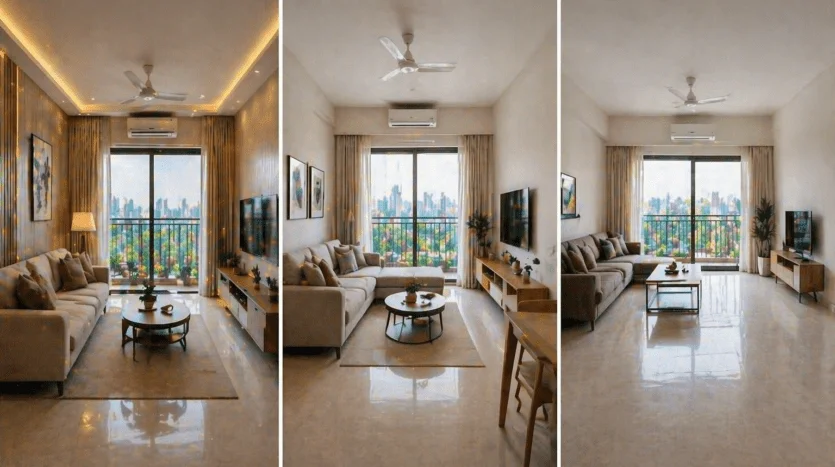
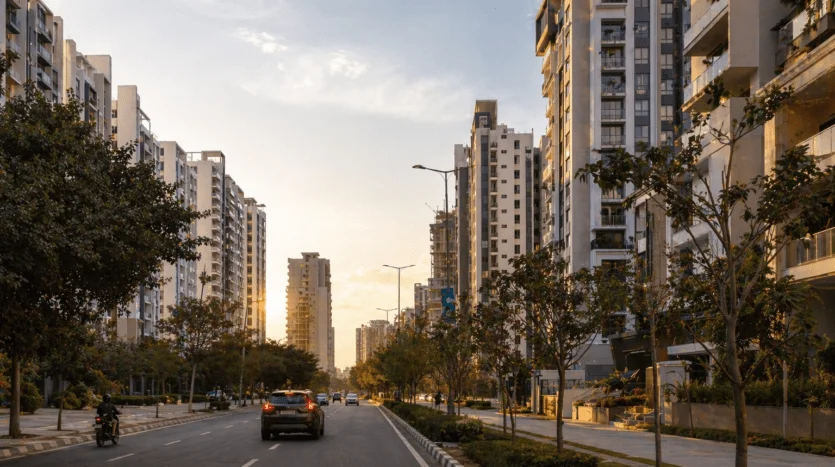
Sarjapur Road has settled into a pattern where demand remains steady because of its proximity to major employment hubs. Locations around Wipro SEZ, RMZ Ecoworld, and the Outer Ring Road continue to influence where people choose to live, especially when daily commute starts affecting how time is spent across the week.
At the same time, buyer expectations have become more specific. A budget like ₹1.5 Cr is no longer seen as a blanket indicator of quality. It is treated as a working range that needs to be evaluated against space, location, and how the home will function over time.
That is where most confusion begins. Two homes priced similarly can deliver very different living experiences. Understanding how ₹1.5 Cr translates across these variables helps reduce that uncertainty and makes comparisons more meaningful.
Sarjapur Road continues to see consistent demand due to its connection to IT corridors and planned infrastructure improvements. Price trends reflect this demand, with steady appreciation supported by both end-users and investors looking for long-term relevance.
Within this context, ₹1.5 Cr sits in a transition range. It allows access to better communities and newer developments, but it still requires trade-offs across key factors.
In the short term, ₹1.5 Cr expands available choices. Over time, the effectiveness of that choice depends on how well the budget has been distributed.
At ₹1.5 Cr, configuration expectations need to be grounded in how projects are actually designed and priced. The outcome varies depending on layout efficiency and location.
| Budget Outcome | Configuration | Typical Usable Range | Where You’ll Find It | What It Feels Like |
| Premium 2 BHK | 2 BHK | ~900–1100 sq ft | Established pockets | More open living, better room sizes, easier daily use |
| Balanced Option | 2.5 BHK | ~1100–1300 sq ft | Mid-zone developments | Extra flexibility without major compromise |
| Compact Upgrade | 3 BHK | ~1200–1400 sq ft | Mixed locations | More rooms, tighter individual spaces |
| Space-First Option | 3 BHK | ~1400–1600 sq ft | Emerging stretches | Larger layout, depends on future infrastructure |
This variation exists because price per square foot changes with location, and developers adjust layouts to match target pricing.
In the first few months, these differences may not feel significant. Over time, they start influencing how smoothly daily routines fit within the home.
At ₹1.5 Cr, configuration is less about the number of rooms and more about how usable those rooms are. Efficient layouts tend to support daily living better than larger but poorly planned spaces.
Sarjapur Road is made up of multiple micro-markets that differ in connectivity, infrastructure readiness, and pricing. The same budget behaves differently across these areas.
| Factor | Established Location | Emerging Location |
| Apartment Size | Smaller within same budget | Larger within same budget |
| Daily Convenience | Immediate access to essentials | Limited in early years |
| Commute | Shorter and predictable | Longer or inconsistent |
| Infrastructure | Already functional | Still developing |
| Resale Demand | More stable | Depends on growth |
| Living Experience (2–3 years) | Settled and predictable | Improves gradually |
Projects closer to established infrastructure and employment hubs command higher pricing, which reduces available space within ₹1.5 Cr.
In the short term, location differences may feel manageable. Over time, they shape daily experience more consistently than configuration.
Choose a stronger micro-location if:
Choose an emerging micro-location if:

At ₹1.5 Cr, every decision involves balancing space, location, and project quality. It is difficult to optimise all three simultaneously.
| What You Prioritise | What You Gain | What You Adjust Later |
| Larger Space | Immediate comfort and flexibility | Longer commute, slower ecosystem |
| Better Location | Daily convenience and accessibility | Smaller rooms, tighter layouts |
| Premium Project | Amenities and brand value | Reduced usable space inside home |
These trade-offs are often not fully visible during the buying stage.
After one to two years, these trade-offs begin to shape daily routines.
The impact of a ₹1.5 Cr decision becomes clearer with time. Small compromises made during purchase often turn into recurring adjustments in how the home is used every day.
The performance of a home changes as routines evolve. What feels manageable during the first few months may require adjustments later.
In the short term:
After one to two years:
After three to five years:
Homes that are designed with better planning tend to adapt more easily. Developers like SUYUG focus on layout efficiency and usability, which helps reduce long-term friction and repeated adjustments.
Long-term comfort depends on how well the home adapts to change. Homes that balance layout, location, and usability tend to remain more stable and easier to live in over time.

When comparing projects within ₹1.5 Cr, simplifying the evaluation helps bring clarity.
Lean toward larger space if:
Lean toward better location
At ₹1.5 Cr, the outcome depends on how the budget is distributed across space, location, and planning. The differences between options become clearer over time, especially when daily routines start interacting with the home and its surroundings.
Buyers can expect 2 BHK, 2.5 BHK, or compact 3 BHK options depending on location and project type. Layout efficiency plays a major role in how usable that space feels over time.
In many cases, yes, but often as a compact 3 BHK or in developing stretches. Prime locations may offer smaller configurations within the same budget.
Location tends to influence daily convenience and long-term value more consistently. Larger space may feel beneficial initially but depends on how it supports routine over time.
They can offer more space and future potential, but infrastructure timelines and daily convenience should be evaluated carefully before deciding.
Focus on layout efficiency, connectivity, and long-term usability rather than only price or square footage.
Start with location, layout, and developer credibility. Once those are clear, compare pricing and amenities to make a more informed decision.
Share it on:



Posted on 04 Jul 2026
3 min read
Posted on 29 Jun 2026
3 min read
Posted on 26 Jun 2026
3 min read
Posted on 26 Jun 2026
3 min read