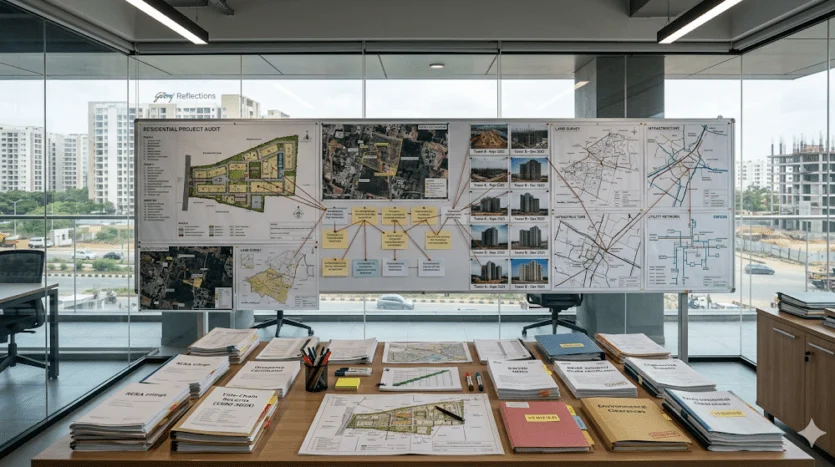
Most property buying guides for NRIs are written for the research phase — the stage where you are still evaluating whether Sarjapur Road is the right corridor, whether Indian real estate belongs in your portfolio, and whether the numbers work in your currency. This guide is for the stage after that decision is made.
NRI buying property in Bangalore remotely involves a specific set of verification steps that most buyers only discover they missed after the transaction is complete. This checklist covers every step from pre-purchase, during purchase, to post-purchase, with the verification methodology for each item, not just the item itself. Two checks that most checklists skip entirely, that’s the Khata audit and the water feasibility audit, are covered in detail here because they represent the two most common sources of post-possession complications for NRI investment in India real estate on Sarjapur Road.
TL;DR
Visit rera.karnataka.gov.in and search by the project’s RERA registration number, not the developer’s name or the project name, which may return multiple entries. Confirm that your specific tower has its own registration number, not just a project-level registration that covers the overall development.
What to check on the portal:
For apartments for sale in Sarjapur Road in multi-phase township projects, tower-wise registration is especially important, later phases may carry separate or pending registration numbers that provide weaker statutory protection.
RERA complaint history is searchable on K-RERA by developer name. Review the developer’s completed project portfolio and check:
A developer with a pattern of delayed interest payments or unresolved complaints on K-RERA is a higher-risk counterparty for a remote NRI buyer than one with a clean record — regardless of marketing claims.
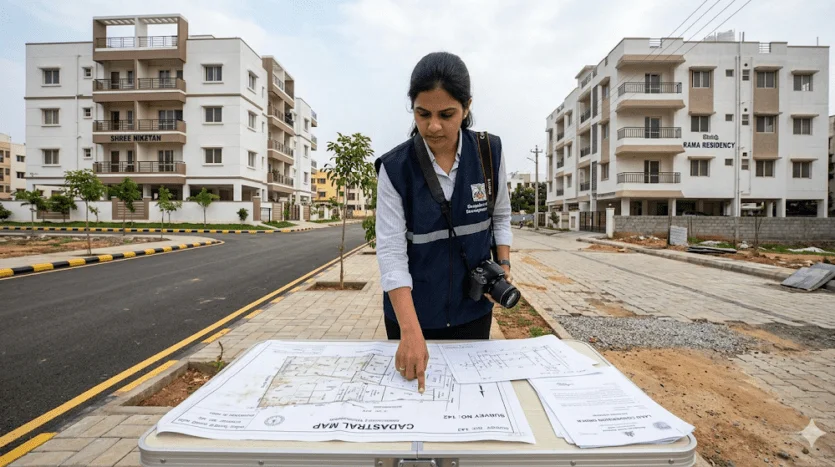
This is the check most NRI buyers skip and most developer blogs don’t explain, and it is one of the two checks most likely to create post-possession complications.
What the Khata is:
The Khata is a BBMP tax assessment document that identifies the property owner and tracks municipal tax payments. It is not a title deed, but reflects the legal compliance status of the structure.
A-Khata vs B-Khata — the critical distinction:
| Parameter | A-Khata | B-Khata |
| Legal status | Fully compliant with all BBMP bylaws and zoning | Secondary register; blocked from sale unless online e-Khata conversion is finalized |
| Bank financing | Eligible for home loans from all nationalized and private banks | Refused by major nationalized banks |
| Utility connections | Full, uninterrupted BBMP connections | May lack official electricity/water connections |
| Building sanctions | Eligible for expansion approvals and trade licenses | Denied construction sanctions |
| Resale risk | Clean | Severely restricted buyer pool at resale |
How to verify:
Request the A-Khata extract from the developer and independently verify via the BBMP e-Aasthi portal. Confirm that both the master plot and the individual undivided share (UDS) of your apartment are classified as A-Khata — not just the land, and not just the project-level.
For NRI buying property in Bangalore, the DC Conversion Certificate is a related document to verify, confirming that land previously classified as agricultural has been legally converted to residential use. Several sub-zones on Sarjapur Road’s eastern stretch (Dommasandra, Attibele) include recently converted agricultural land. Missing DC Conversion Certificate on the survey number of your plot creates FEMA exposure; buying on unconverted agricultural land is a FEMA violation.
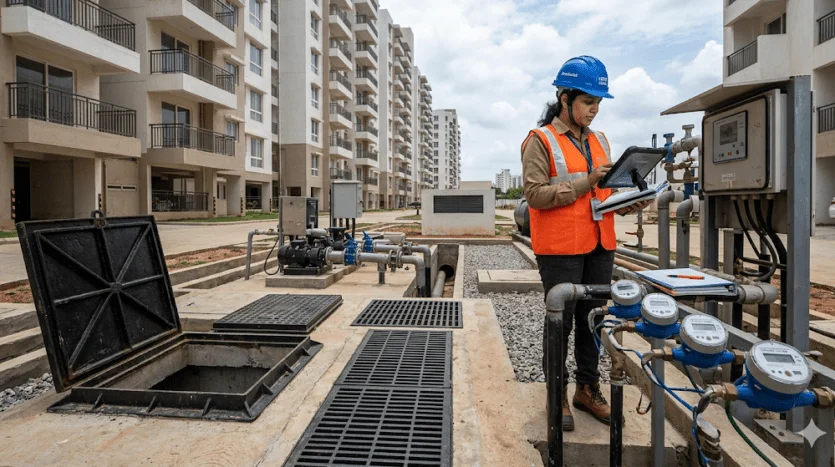
The water supply question is the most consistently omitted due diligence step in NRI property transactions on Sarjapur Road and it has meaningful long-term cost implications.
The Cauvery Stage 5 reality:
The BWSSB commissioned the Cauvery Water Supply Scheme Stage 5, bringing an additional 775 MLD to Bengaluru. However, last-mile tertiary distribution networks across many peripheral BBMP wards and the 110 newly added villages, including parts of the Sarjapur Road corridor, are still incomplete. Newly constructed apartments in these areas remain dependent on borewells and private water tankers.
Central Ground Water Board (CGWB) data indicate that groundwater tables across Sarjapur’s peripheral zones have dropped by 18–22 metres over the past decade, reducing borewell reliability and driving up tanker costs.
The water checklist:
Suyug’s projects at Sompura Gate carry IGBC Silver pre-certification, which mandates operational rainwater harvesting, smart water metering, and zero natural wood usage; sustainability specifications that are particularly relevant in the context of Sarjapur Road’s water profile.
All payments must flow through NRE, NRO, or FCNR accounts. Direct transfers from an overseas bank account to a developer’s account are not FEMA-compliant and compromise repatriation rights at exit.
For construction-linked payment plans, confirm:
Maintain remittance documentation (bank statements, wire transfer records, NRE account transaction history) from the first payment. This documentation is the evidence of FEMA-compliant payment that protects repatriation rights when you eventually sell.
The sale agreement is the document that governs every obligation in the transaction, and it should be reviewed by an independent lawyer, not the developer’s recommended legal team, before the POA holder signs anything.
What to verify in the sale agreement:
Engage your lawyer to conduct a 30-year title search tracing the chain of ownership from the original title to the current developer. Obtain an Encumbrance Certificate (EC) independently via Kaveri 2.0 Web Platform (kaveri.karnataka.gov.in). Do not rely on the developer’s copy.
The EC confirms no active mortgages, legal liens, or family disputes on the property. For under-construction projects, also verify the Commencement Certificate (CC), confirming the developer has legal permission to build according to the approved plan.
Execute a transaction-specific POA, ie., limited to the defined property and set of actions. A general POA carries significantly higher misuse risk.
The valid POA process:
Every payment in the transaction, from the booking amount, and construction instalments, to the stamp duty, and registration fee, must be made via NEFT, RTGS, or demand draft from your NRE or NRO account. Cash payments of any amount are prohibited and create FEMA violations that cannot be remedied retrospectively.
TDS also applies to advance and token payments to NRI sellers in secondary market transactions, not just the final balance.
For NRI investment in India real estate, TDS planning at the point of purchase prevents a cash flow problem at the point of exit.
The key action: when you eventually sell, apply for Form 128 (formerly Form 13, the Lower Deduction Certificate) before the sale deed is executed. Without it, the buyer deducts TDS on your gross sale consideration not your actual capital gain. On a ₹1.5 crore sale with ₹30 lakh in actual gains, this difference can exceed ₹15 lakh in capital locked in a government refund cycle for 12–24 months.
Plan for Form 128 at the time of purchase. Maintain complete cost of acquisition documentation (purchase agreement, stamp duty receipts, registration receipts, home loan statements) from day one. These documents are required to support the Form 128 application at exit.
Within 3–6 months of possession, initiate the Khata transfer from the developer’s name to your name via the BBMP e-Aasthi portal. This establishes you as the assessed owner for property tax purposes and is a prerequisite for future resale, rental registration, and utility connections.
Simultaneously register for property tax in your name, as failure to do so means property tax accrues against the developer or previous owner record, creating arrears that complicate resale.
Execute a registered lease agreement for any tenancy above 11 months. Unregistered leases above 11 months are not legally enforceable in Karnataka. The registration process is handled at the local Sub-Registrar’s office and can be coordinated via your POA holder or property manager.
Rental income must be credited to your NRO account. Ensure the tenant deducts TDS at 31.2% and deposits it under your PAN; verify the credit appears in your Annual Information Statement (AIS) alongside Form 26AS.
Appoint a professional property management agency before handing over keys not after the first tenant vacancy. The appointment should cover:
Management fees typically run 8–10% of monthly rent. Factor this into your net yield calculation from the outset, not retrospectively.
| Audit Check | Document Required | Verification Method | Safe Signal | Red Flag |
| RERA registration | Tower-wise RERA number | rera.karnataka.gov.in | Active, tower-specific; no complaints | Pending, project-level only, or complaints |
| Builder track record | Complaint history | K-RERA + confonet.nic.in | Clean record; on-time deliveries | Active delay notices or recovery orders |
| A-Khata status | BBMP e-Khata extract | BBMP e-Aasthi portal | A-Khata on master plot and UDS | B-Khata entry; missing DC Conversion |
| Water feasibility | BWSSB certificate | Direct from developer + cross-verify via BWSSB Web Portal | Valid BWSSB feasibility certificate | No certificate; 100% borewell dependent |
| Title chain | EC + Mother Deed | Kaveri 2.0 Platform (kaveri.karnataka.gov.in) | Clear 30-year chain; no encumbrances | Missing deeds; active litigation |
| OC status | Occupancy Certificate | BBMP/BMRDA issuing authority | Valid OC issued | OC pending; CC only; “OC in progress” |
| Bank pre-approval | Loan sanction letters | Request from developer | Pre-approved by SBI, HDFC, ICICI | Refused by nationalized banks |
| Payment compliance | NRE remittance records | Your bank statements | Clean NRE/NRO trail from first payment | Cash receipts; overseas direct transfer |
Download Suyug’s NRI buyer guide: a complete reference document covering RERA verification, Khata audit, water feasibility, POA execution, and post-possession setup. Or speak directly to our NRI team to start your Sarjapur Road investment.
The checklist above is longer than most buyers expect, and shorter than the actual process feels when you are doing it from abroad without local context. The items that matter most are the ones most commonly skipped: the Khata audit, the water feasibility certificate, and the tower-wise RERA check,, rather than project-level. None of these is difficult to verify. They all take under an hour with the right portals. And the NRI buyers who do them before booking are the ones who don’t discover problems after.
Visit rera.karnataka.gov.in from anywhere. The portal is publicly accessible without registration. Search by the RERA number the developer provides and confirm the entry shows your specific tower, its registered completion date, the approved building plan matching what you are being sold, and no active complaints or enforcement notices. This takes under 15 minutes and should be done before any booking discussion.
A verified e-Khata is now strictly mandatory for all property registrations, transfers, and sales inside Bengaluru. A-Khata confirms the property complies with all BBMP bylaws and is eligible for nationalized bank financing, utility connections, and future building sanctions. B-Khata is a secondary tax register entry for properties with structural deviations. These cannot secure home loans from major nationalized banks, face restricted resale, and carry demolition risk if regularisation is challenged. However, the Karnataka Government officially institutionalized an online B-to-A Khata Regularization Module on the e-Aasthi platform.For NRI buyers who may eventually want to sell or refinance the asset, A-Khata status is non-negotiable.
Cauvery Stage 5 brought additional water supply to Bengaluru, but the last-mile tertiary distribution networks across many peripheral Sarjapur Road sub-zones are still incomplete. Many projects in these areas remain dependent on borewells (whose water tables have dropped 18–22 metres over the past decade) and private tankers that cost ₹2,500–₹4,000 per month. Before buying, request the developer’s BWSSB Feasibility Certificate confirming grid connectivity, and verify the project has operational rainwater harvesting and STP systems.
Yes via a transaction-specific POA attested at your nearest Indian Embassy or Consulate and apostilled (for Hague Convention countries including US, UK, Canada, UAE) before being adjudicated at the Sub-Registrar’s office in India within 90 days of arrival. Your POA holder executes registration on your behalf. Suyug’s NRI advisory team manages the full coordination remotely..
At the point of purchase, not at exit. Maintain complete cost of acquisition documentation from day one: purchase agreement, stamp duty receipts, registration receipts, and home loan statements if applicable. These are required to support a Form 128 (Lower Deduction Certificate) application when you sell, which reduces TDS from the gross sale value to actual capital gains only. On a ₹1.5 crore sale with ₹30 lakh in actual gains, applying for Form 128 can free over ₹15 lakh in liquidity at the point of transaction rather than locking it in a 12–24 month refund cycle.
The two most commonly missed are the Khata transfer and the property manager appointment. Khata transfer from the developer to buyer’s name must be completed within a few months of possession via the BBMP e-Aasthi portal. Delay creates property tax arrears that complicate resale. Property manager appointment should happen before the first tenant, not after the first vacancy. Tthe tenanting period without a manager is the window where most remote management problems originate.
Share it on:



Posted on 04 Jul 2026
3 min read
Posted on 29 Jun 2026
3 min read
Posted on 26 Jun 2026
3 min read
Posted on 26 Jun 2026
3 min read